Saplings

9 Studevant Street, Norwich, Connecticut

By the trunk of every family tree are saplings that we suspect are connected somewhere below. James Lynch is one of those saplings. I know a lot about him, but not where we connect. He and his wife, Margaret Collins, were both Irish immigrants—James arriving in Norwich, Connecticut, in 1857. The two married in 1859 and raised a family of six children in the Bean Hill section of the city. James worked most of his long life as a “finisher” in the nearby Clinton Textile Mill. His children joined him at the mill when they finished school. James enlisted in the Union Army of the Civil War in 1867, but deserted three months later. had a sister in town, Elizabeth, who passed away in 1903 in the Norwich Alms House (the house for the poor).

Being a Lynch in Norwich doesn’t mean we’re related necessarily, but it certainly increases the chances quite a bit. That’s not because Lynch is a rare name; it isn’t—Lynch is one of the 20 most common Irish names. I’ve tracked quite a few of my ancestors to this small southeastern Connecticut city. Actually, I can track James even closer to my family: from 1872 to 1892 when James Lynch lived in this house by the Yantic River, his next-door neighbor was Michael Lynch, my great great grandfather’s brother. The two families had children who shared some of the same names that run through the generations: John, Mary and Margaret.

Putting all my research together, I see James and his sister Elizabeth Lynch as probably my first Cousins 4X removed. What I need as proof is a record that connects their parents, James and Mary (Murphy) Lynch, to my branch of the family back in Cahersiveen, County Kerry, Ireland. Perhaps this sapling will lead to another tree tangled up with the same roots. Maybe James will lead me to my known DNA connections on the island of Valentia, across the way from Cahersiveen. There were James Lynches there, too, with relatives all around Norwich, Connecticut. The more I dig, the more I see how we’re all connected.

Blood (Meridian) Relative

Eames Street, Providence, Rhode Island

Cormac McCarthy slept here — at least for a nap or two. The award-winning author of The Road, No Country for Old Men, Blood Meridian and All the Pretty Horses writes of America’s West, but was actually born in the East. This was his grandparent’s house in Providence, Rhode Island. How do I know this? Or, more importantly, why would I know this? Because I’ve learned from my research that Cormac McCarthy’s grandmother and my great-grandfather were brother and sister. That makes the famous author my second cousin, once removed. I can assure you that’s not close enough to get a holiday card… or to even be known of.

Helena (Ellen) O’Keefe McGrail, passport photo, 1922


Finding this famous relative was a fun puzzle to solve. A bookish cousin of mine spoke of my uncle’s vague memory of playing with a boy named Cormac at a family gathering a long, long time ago, when they were children. My uncle and Cormac McCarthy were both born in Providence around the same time. Could there actually be a connection? One clue led to another, and before too long, the mystery was solved. It turns out that Cormac’s grandmother, Helena O’Keefe, was the sister of my great-grandfather, Daniel O’Keefe. They were immigrants from the small town of Churchtown South in East Cork, Ireland. They followed other family members and neighbors to faraway Providence. Helena came in the early 1890s and married William McGrail, the son of an Irish immigrant in 1898. On their marriage certificate, she is described as a dressmaker. William was a house painter, working with his father. The McGrail’s business seems to have done well, as they had by far the biggest house and in a nice neighborhood too — the East Side of the city. They lived at the top of the hill. The other O’Keefe’s lived down below.

1898 marraige of William McGrail and Ellen O’Keefe
1935 Rhode Island State Census


Nora and William McGrail had three children; the youngest, Gladys, married Charles Joseph McCarthy, a young lawyer, in 1930. The McCarthy’s had four children; the third, Charles Joseph Jr., was nicknamed “Cormac,” a reference to the Irish chieftain, Cormac McCarthy of Blarney Castle. The McCarthy family moved to Knoxville, Tennessee, when Cormac was young — his father Charles going to work for the Tennessee Valley Authority. Cormac McCarthy’s stark Western tales are now world famous, while the story of his Eastern beginnings is foggy at best.

1940 Census, McCarthys in Knoxville, Tennessee

The Cooper and His Wife

Fish House (1838) York Harbor, Maine


The oldest structure I found on the shore of York Harbor in Maine was this weather-beaten one, with a sign that said “Fish House 1838.” Believe it or not, my ancestors were here 202 years before then.

William Dixon came to America along with 700+ Puritans led by future governor John Winthrop. They came in a fleet of eleven ships from Isle of Wight, England, in 1630. Dixon, like Winthrop, was from Suffolk, England, emigrating to establish the Massachusetts Bay Colony. Sometimes referred to in documents as “Dixy,” William was an indentured servant to Governor Winthrop for a few years in Boston, before taking off for faraway Maine, leaving behind disputed financial settlements which caught up with him later. William set up shop along this wharf as a cooper and married in 1636. He was a signer to petitions objecting to Massachusetts absorbing Maine into its colony in the 1650s, and he died here in March, 1666.

From what I can tell, William’s wife, Joane ,was actually my true ancestor. The book History of York, by Charles Edward Banks (1931), describes William Dixon as the step-father to Dorothy Dixon (my 8x great-grandmother). Who Dorothy’s father (and Joane’s first husband) was, I don’t know. I’m not even sure what Joane’s last name was. Sometimes it’s listed as Pierson, sometimes Watts, and all too often, “?”  I know she moved into their daughter Dorothy’s home nearby upon William’s death. But when she died is unrecorded. This is indicative of the fact that records too often gives us the facts of the men, but not the women—denying us half of the stories. 

Landowners of York, Maine, 1652
History of York, 1931

The Ferryman

Stage Neck, York, Maine

This is Stage Neck in York, Maine, and right here, at the place of this rotting old wooden bridge, is where my 8x great-grandfather William Moore worked as a fisherman and ferryman in the 1600s. I believe William came here in 1851 as an immigrant from southeastern England. In 1653, he married locally-born Dorothy Dixon, and together they raised a large family. 


William wasn’t pleased when the Massachusetts Colony swallowed up the Province of Maine, so he signed a petition against it in 1679. He then signed a letter to the King of England to further object in 1680. Maine was part of Massachusetts until it became its own state in 1820. While I sat and drew at low tide on a clear, warm spring day, I enjoyed having the place to myself. Apparently, William did too, as he fought to win a monopoly on Maine ferrying in 1683. The very next year, he sued to keep it that way. 

William Moore, York Maine, 1652
York, Maine Landowners
1679 Petition against sale of Maine to Massachusetts
book of New England family histories

Crowded House

Studevant Street, Norwich, Connecticut

Michael Lynch left his family’s tiny patch of rented turf on the shore of Dingle Bay in 1855 with his new bride Mary Fenton, and headed to Connecticut, never to return. (One census states that Mary came a year after her husband.) Michael ended up in Bozrahville, Connecticut, a little mill town on the Yantic River where there was a small rubber processing mill. He worked preparing rubber for the much bigger Hayward Rubber Company up the river in Colchester. There are rumors that Nathaniel Hayward, the founder of the company, recruited workers in southwestern Ireland and sent a ship that brought many to the US together (perhaps including Michael), but I’ve not found any confirmation of that. What I do know is that the little mill in rural southeastern Connecticut employed relatives and old neighbors of Michael’s from back in County Kerry, Ireland, who all seemed to arrive at around the same time. I also know that his uncle, John Lynch, preceded him to the area by a decade, and lived in nearby Norwich. 

1860 Census, Bozrah, Connecticut


Michael Lynch lived in this Norwich house for decades, having moved in after a decade at the rubber mill. He worked as a “laborer” for the rest of his life, and he and Mary filled the house with ten children. From census forms, I know in 1870 Michael and Mary rented this place, and by 1900, they owned it. From those forms we can see that they could neither read nor write. By then their oldest child John, was renting the house next door for his growing family.


In 1890, Michael’s brother, my great-great grandfather John Patrick Lynch, and his family lived in this house too, with his wife Mary and five of their six surviving children. They had come to America much later, in 1884—first working in a textile mill in Pawcatuck, Connecticut, and then moving to Norwich where they found work in factories. After John Lynch moved out, many of Michael Lynch’s family stayed on, living here for many years. Despite feeling close to the house, I kept my distance—because a number of signs, flags and bumper stickers on the property encouraged me to do so.

Death Certificate for Michael Lynch
Obituary for Mary Fenton Lynch

Mr. Robinson’s Neighborhood

Captain Joel Robinson House, Attleboro, Massachusetts

Robinsons have been in Attleboro, Massachusetts, since the beginning of white settlement, and they’ve fought over their place from the start.


George came first, way back in the 1640s. He was an immigrant—from England most likely (some say Scotland)—who joined the community of Rehoboth on the western edge of the Plymouth Colony. He married Johanna Ingraham there in 1651. George was my 8x great-grandfather, and he fought alongside his son George Jr. in King Philip’s War against the local Native Americans who were being pushed off their ancestral lands. 


Noah Robinson, of the next generation, fought in the Seven Years War (also known as the French and Indian War). Noah’s sons and nephews fought for independence at the Battle of Bunker Hill.  


Another fighter in the Revolutionary War lived in this house: Joel Robinson (my second cousin 6x removed). He built this handsome home on a winding country road in 1790 for his marriage to Margaret Blackinton. Generations of ancestors lived here (and maybe still do). 


I grew up about five miles from here in Cumberland, Rhode Island, in a slice of the town that used to be part of Massachusetts called Attleboro Gore. There were Robinsons there, too. 


As I’ve written many times, my family didn’t know before this research that our Canadian ancestors were transplants from Colonial America. That migration story was lost long ago. Now I’m up pulling up hidden roots that are very deep and practically under my feet.

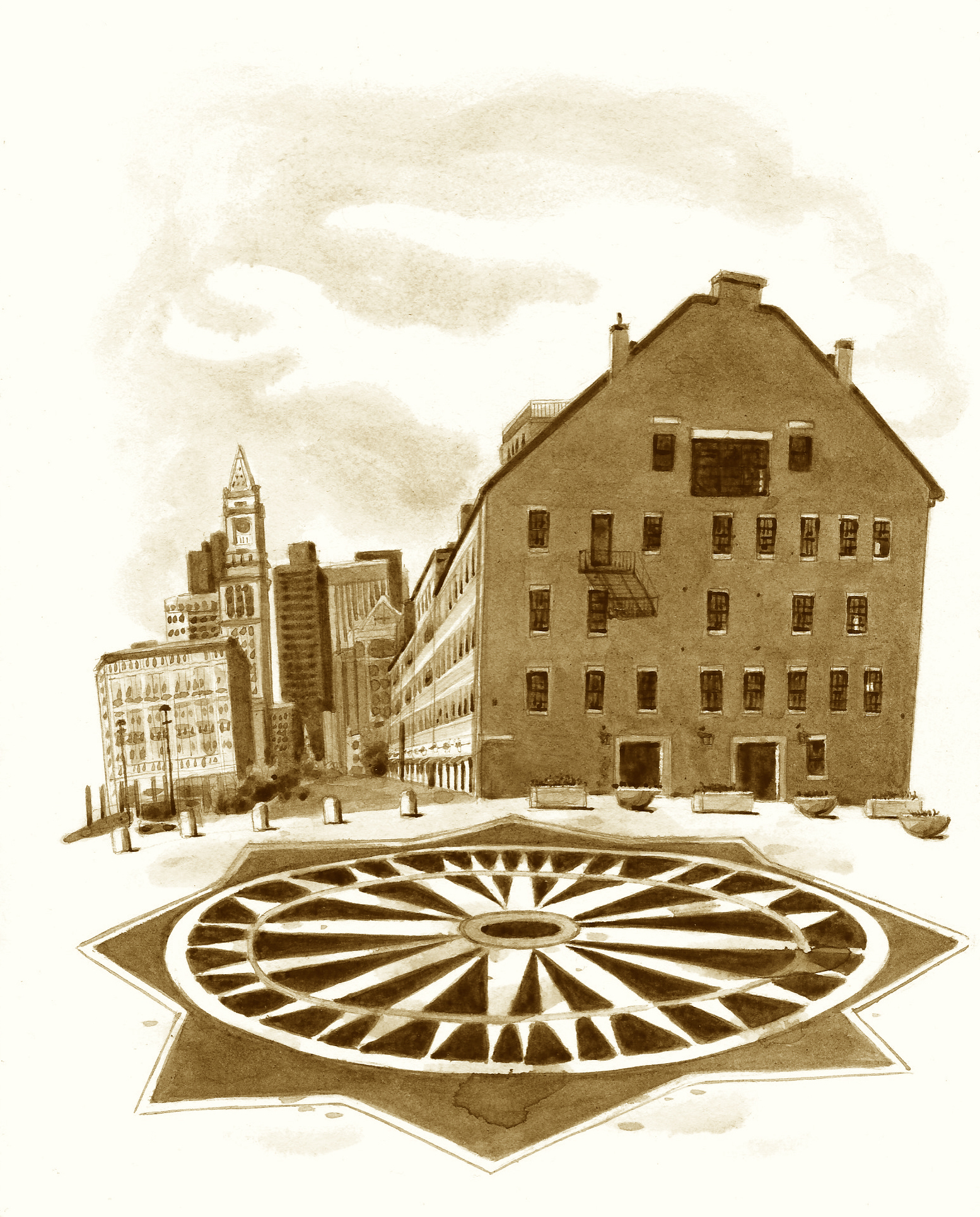
Long Wharf


Long Wharf, Boston, Massachusetts

Boston’s Long Wharf used to be longer and its history goes way back. It was built in the 1710s and, looking at old maps, one can see that it extended for a half mile — from where I stood to the Custom House Tower (the pointed building a few blocks away) on State Street. Over time, the shore was extended, making the wharf shorter.

1905 Map of Boston Harbor with Long Wharf marked.


But even as it shrunk, Long Wharf continued to play an important role in the history of Boston and in the history of my family. This was the welcome mat to immigrants landing in Boston. The huge compass added in 1990 acts as a bullseye to where many of my ancestors stepped onto their “New World.”

The last of my many, many immigrant ancestors arrived here on September 8, 1906, on the steamship S.S. Republic from Queenstown (now Cohb), Ireland. They were Daniel and Helen (Ivers) O’Keefe, my great-grandparents, along with Daniel’s brother, Maurice. The trip cost them $60.00 each. They followed family here, seeking more opportunities than they had back home under British rule. The O’Keefes stepped onto a pretty tattered Long Wharf at that time – soon after, immigration was moved to new facilities in East Boston.

1906 SS Republic arrival in Boston from Ireland

None of my arriving family passed by the Statue of Liberty. None were processed at Ellis Island. My Irish Famine ancestors came to New York before those places existed. My other Irish ancestors came through Boston. And my Puritan ancestors landed in Ipswich, Salem, Boston — and more, I assume.

As I’ve written before, I knew Helen O’Keefe because she lived to be 102 years old – dying when I was 13. For this American, Grandma O’Keefe was the last living connection to someplace else.

Beach Glass

Philip’s Point, Germantown, Quincy, Massachusetts

Peter Etters, my 6x great-grandfather, was raised a Mennonite, knew Benjamin Franklin and John Adams, and lived here in Quincy, Massachusetts—until the trouble started. Like the other subjects of this onsite drawing series, Peter was an immigrant to America. He came to Philadelphia, Pennsylvania, in 1735 from Bern, Switzerland, with his father, Johannes, and some siblings. They followed other Mennonite families who came before them from Germany and Switzerland. By 1737, the Etters were farming 100 acres in Lancaster County.

Peter became a weaver, and in around 1750 he relocated at the advice of Benjamin Franklin to Quincy, Massachusetts, to partner with Franklin’s brother John, along with a German immigrant, Joseph Crellius in the building of a glass foundry on the shore of Town River Bay. Peter came to further develop his own stocking weaving business as well. Future President John Adams lived not far away. Other German craftsmen came to the area to work and to start businesses, too, such as chocolate making. The glass factory started out strong, making windows for Boston’s prestigious King’s Chapel, but failed three years later—unable to recover from a fire caused by lightning.

Peter Etter’s stocking business carried on and prospered with clients such as the British Army, but in 1775, as the American Revolution erupted, Etters found himself on the wrong side of history. He was a Loyalist, siding with the British, so he and his family moved to Boston for better protection. Then in March 17, 1776, he was evacuated along with 1000 other Loyalists and 11,000 British troops on a fleet of ships to Halifax, Nova Scotia, because George Washington and the Colonial army was about to overtake the city. To this day, Evacuation Day is a holiday in Boston. Left behind by my fleeing ancestor is an area of Quincy that has forever been called Germantown. In 1979, an archeological dig turned up remains of the foundry, as well as some glass fragments along the shore. My recent walk down the dirty beach offered only a Bud Lite bottle.

Massachusetts Archaeological Society, 1979

Book of early immigrants to Pennsylvania, title and date unknown
1737 Land of John (Johannes) Etter, Lancaster, Pennsylvania

Transcription of Loyalist evacuees from Boston 1776 (partial), book title and date unknown

Military Heart

38 Burnside Street, Providence, Rhode Island


Thomas O’Keeffe had a bad heart, but he loved the military life. A seemingly restless man, he was my great-grandfather’s younger brother, born in 1877 in the little Irish town of Churchtown South, in eastern County Cork. Not long after immigrating to Providence, Rhode Island, he joined the US Army. That was in 1899, soon after which he was involved in the Spanish American War. A year later, he could be found by the US census on a military base in Cuba. In 1902, he was discharged from the army with a heart problem, but in a matter of months, remarkably, he reenlisted. A 1904 Army record places him in a military base hospital in Manilla, Philippines. One year later, he was again discharged from the Army at the Presidio in San Francisco, due, not surprisingly, to his bad heart. Not long after his return to Providence, he married Rosella Feeney, and by 1910, they had two daughters and Thomas was working at the huge Brown & Sharpe factory as a “machinist’s helper.” The O’Keeffes moved from house to house, ending up at this house on the South Side of Providence in 1918, a year after Thomas spent time in a veterans hospital in Dayton, Ohio.


Throughout the years, Thomas often listed himself as American born—rather than Irish—and single—rather than married. What helped me track this moving target was that he always listed his brother Daniel (my great-grandfather) as his primary contact in his records. In 1918, in one last bid for adventure at the age of 40, Thomas went to Montreal and enlisted in the Canadian Overseas Expeditionary Force. He was now calling himself single and Irish. Two months later, he was discharged as “unfit” for service. The very next year, Thomas Joseph O’Keefe died of heart failure and was buried far away—in a military graveyard in Milwaukee, Wisconsin. His wife Rosella received his military pension and stayed in Providence – the place she never left.

1899 Army Enlistment, Boston, Massachusetts

1904 Manilla, Phillipines Military Hospital

1917 Military Hospital, Dayton, Ohio

1918 Enlisting in the Canadian Over-Seas Expedition Force, Montreal, Canada

1919 Military Death Record of Thomas O’Keefe

Afraid to Look

Old State House and 53 State Street, Boston, Massachusetts


In the heart of downtown Boston, on State Street, close to the iconic Old State House, there’s a plaque on the wall of an office building marking the former location of the celebrated Bunch of Grapes Tavern. That tavern, which was in operation for most of the 18th century, was full of history, including my own family’s. My 5x great-grandfather, Samuel Wethered, ran it from around 1743 until his death in 1758. Samuel was an immigrant from England who married Sarah Thornton (possibly American-born) in 1731, in Boston. Before Samuel took over Bunch of Grapes, he briefly ran Ye Crown Coffee House and the Rose and Crown Tavern, which were also on State Street—a bustling area, then called King Street. 


The Bunch of Grapes was where the first Masonic Lodge in North America was organized 1733. In the 1770s, it was a place where Paul Revere, Samuel Adams, and John Hancock plotted against the British. The first opera heard in English-speaking America was staged there. Land-granted Ohio State University was planned there. The Boston Massacre exploded across the street. What happened while Mr. Wethered was the owner? To be honest, I was afraid to look, because not long after I started researching, I learned that Bunch of Grapes was among the venues along King Street that hosted slave auctions. A newspaper advertisement from the late 1860s names Bunch of Grapes specifically. While that was after Samuel’s death, when he was alive, ten percent of Boston’s population was Black and I can’t help but suspect that auctions were held in that time period as well. As to whether Samuel himself had slaves, I don’t know, but his children eventually did. Samuel Jr. moved to Nova Scotia after his father’s death and had at least one recorded slave up there. John and Thomas moved to Antigua in the West Indies and had slaves. Nameless enslaved humans are passed along in John’s Last Will and Testament. I don’t think the brothers were plantation owners, but they were enriched participants in the Triangle Trade of rum from New England, sugar from plantations in the West Indies and slave labor from Africa. It’s a shameful past and is upsetting to learn. I carry the American scar.

Bunch of Grapes Tavern

Exchange Building, 53 State Street, Boston

from Boston newspaper: The Boston Gazette & Country Journal, late 1760’s
from a history of Ye Crown Coffee House

1770 The Fruits of Arbitrary Power, or The Bloody Massacre by Henry Pelham

“Antigua Slaves Digging the Cane Holes” from Ten Views in the Island of Antigua, 1823
Design a site like this with WordPress.com
Get started